

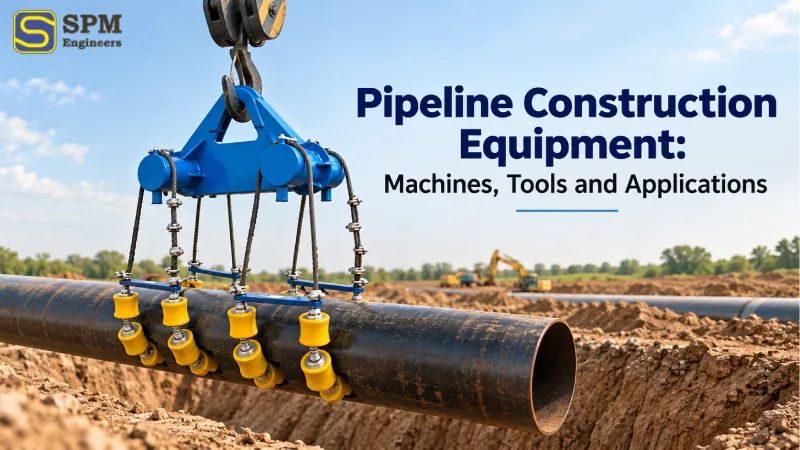
Delays on a pipeline job often begin with a small mismatch between the pipe and the tool being used. Contractors need suitable equipment for handling, joint preparation, welding and placement, not simply more machines on site.
At SPM Engineers, we manufacture and export Pipeline Construction Equipment for oil and gas projects. Our range covers several work stages, helping buyers plan purchases around actual site operations.
Start With Pipe Handling and Positioning
Pipe sections need controlled support before crews can prepare joints or move them into place. Our product range includes cone-type pipe rollers, motor-driven pipe rollers, beam clamp rigging rollers and pipe rotators. These options serve different handling arrangements, so selection should begin with the movement required at the site.
For example, a supported pipe that must rotate presents a different requirement from one that needs to travel along a work area. Our rollers and rotators give procurement teams several configurations to consider. Discuss pipe diameter, intended movement and available working space before deciding which equipment belongs in the handling sequence.
Select Alignment Tools for Welding Work
Welding quality depends partly on how pipe ends are brought together and held during preparation. We manufacture manual internal clamps, hydraulic internal clamps, cage-type clamps and ratchet-type external clamps. Each belongs to a different alignment approach, making the intended welding setup an important purchasing detail.
Our range also includes pipe welding pneumatic clamps for pipeline work. Buyers should share the pipe dimensions and welding arrangement so the chosen clamp can be assessed for its intended application. A project that involves repeated field joints may need a different workflow from a fixed fabrication area, even when both involve steel pipe.
Prepare Pipe Ends With Cutting and Heating Tools
Joint preparation requires equipment suited to the planned cutting and welding procedure. We offer motorised pipe cutting crawlers with tracks, manual cutting crawlers, chain-drive options and chain-type cutting machines. Our catalogue also includes internal and external pipe end heating torches.
These tools address separate tasks. A cutting machine is selected for the required cutting operation, while a heating torch is considered when the project procedure calls for pipe end heating. Discussing the sequence in advance helps our team identify the relevant products without suggesting that one machine can perform every preparation job.
Plan Lifting, Lowering and Bending as Separate Operations
Moving a pipe section and placing it into a trench call for attention to support and contact points. We offer pipe lowering cradles, lowering belts, choker belts and lifting hooks with nylon inserts. These products provide options for lifting and lowering arrangements used in pipeline construction.
Our pipe lifting and lowering equipment should be considered alongside the planned lift and pipe surface condition. We also manufacture pipe bending machines, bending shoes and hydraulic wedge mandrels for projects that include bending work. Bending equipment is a separate selection decision, based on the pipe and the required operation rather than on lifting needs.
Confirm Product-Specific Dimensions Before Ordering
The term Pipeline Construction Equipment covers many machines and accessories, so specifications must be checked against the individual product. One equipment configuration is described with polyurethane material and a 6-inch to 64-inch size range. Those details should not be treated as specifications for every clamp, roller or machine we supply.
Our team asks buyers to identify the product type, pipe dimensions and work stage first. The next step involves identifying the appropriate specifications, load capacity, and material requirements for the selected equipment. This approach prevents a general catalogue description from being mistaken for a technical approval of a particular site setup.
Why Choose SPM Engineers?
We have manufactured and exported oil and gas pipeline products from Ahmedabad since 2016. Our catalogue spans pipe rollers, welding clamps, cutting machines, heating torches, bending tools and lowering accessories. We help buyers discuss equipment by application and configuration, with attention to the different tasks that make up a pipeline project.
Conclusion
A practical equipment plan follows the sequence of work: handling first, then alignment and joint preparation, followed by lifting or other required operations. Our product families give contractors several ways to approach those tasks. When selecting Pipeline Construction Equipment, confirm the exact item specifications instead of assuming that a catalogue-wide description applies to every machine. Providing your project requirements in advance allows our team to recommend equipment suited to different phases of the operation.
Looking for reliable pipeline construction equipment for your upcoming oil and gas project? Speak with SPM Engineers about your pipe sizes, required machines and operating conditions.
Call +91 9974928709
Or Email: info@spmengineer.com