
A coated pipe can pick up marks when it moves against unsuitable support during trench placement. Contractors therefore need to think about contact surfaces as carefully as lifting arrangements.
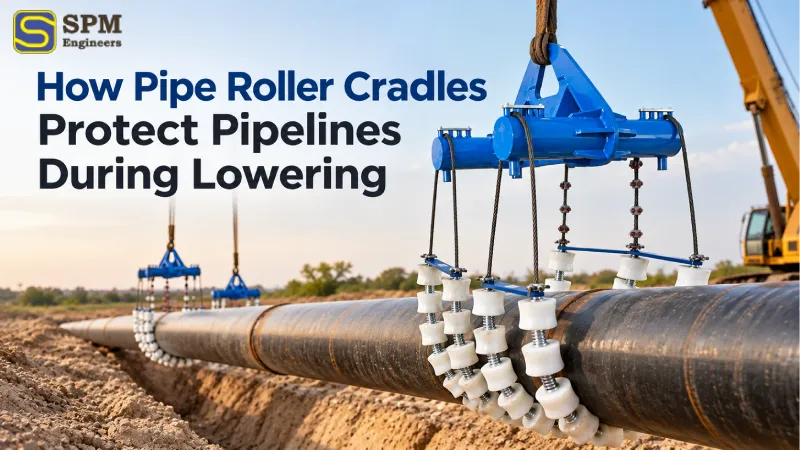
At SPM Engineers, we manufacture Roller Cradle equipment for pipeline projects where pipe sections travel along the line and are lowered after welding. Our product is intended to support movement while reducing the chance of damage to the pipe's outer coating.
Keep the Coating Away From Abrasive Contact
During line travel, a pipe must move over support points without unnecessary rubbing. Our pipe roller cradles feature specially designed, non-marking rollers that minimize the risk of damage to the pipe’s external coating. They are designed for inline travel and for placing welded pipe sections into trenches, making coating protection part of the handling plan.
We describe these components as non-marring rollers, supported by anti-friction bearings mounted on high-strength cables. This arrangement supports rolling contact during movement rather than depending on an unprotected contact surface. Operators must still watch the pipe path and check for sharp edges or debris around the lowering area.
Support a More Controlled Lowering Sequence
Lowering a welded pipe section involves changing its position while maintaining suitable support. Designed for pipeline installation, our roller cradles assist in safely lowering welded pipe sections into trenches after welding operations are complete. The rollers let the pipe move along the line as the placement sequence progresses.
A Roller Cradle should be selected as part of the lifting and lowering arrangement, not treated as a substitute for it. Before the operation, crews should check the planned movement, positioning of support equipment and access around the trench. Clear communication among the workers involved remains necessary throughout the process.
Check the Listed Capacity Against the Actual Load
Our product information specifies a lifting capacity of 30 tons per set for the listed pipe roller cradle. The construction material is identified as mild steel. These details give buyers a starting point for technical discussions, but the figure should not be transferred to other models or different lifting configurations without confirmation.
We recommend sharing the actual pipe weight, diameter and intended setup when asking about a Roller Cradle. The handling team must assess the full arrangement, including how loads are distributed and how many support points are needed. Capacity selection should follow the approved lift plan rather than a single catalogue figure.
Match the Cradle to the Pipe Diameter
Pipe diameter affects the contact arrangement and the equipment selected for lowering. Our listed roller cradle options cover pipes from 2 inches through 48 inches, with configurations described for diameters up to 60 inches. The applicable version should be confirmed before procurement, especially near the extremes of the stated range.
Our products are made for oil and gas pipeline construction, including work associated with trench laying. Buyers can discuss the relevant diameter and required movement with our team. Suitable pipeline lowering operations depend on the relationship between the selected cradle, the pipe section and the planned handling method.
Inspect Rolling Components Before Moving the Pipe
A good lowering plan also considers the condition of the equipment on the day of use. Check the visible rollers, bearings and cable arrangement for damage or obstruction before placing a pipe on the cradle. If movement is restricted or a contact surface is damaged, the equipment should be assessed before work continues.
Our design uses anti-friction bearings and high-strength cables to support rolling movement. These components deserve particular attention because they are part of the contact and support arrangement. Buyers can also confirm the required configuration with us when selecting equipment for repeated handling work on a pipeline project.
Why Choose SPM Engineers?
We manufacture pipe roller cradles in India for oil and gas pipeline applications. Our listed product uses mild steel construction, non-marring rollers and anti-friction bearings, with a stated 30-ton-per-set capacity. We discuss pipe size and handling requirements with buyers so the proposed cradle can be assessed for the intended project arrangement.
Conclusion
Protecting a pipeline during lowering calls for suitable support, controlled movement and careful inspection. Our cradle design helps reduce unwanted contact with the outer coating as welded pipe sections travel toward trench placement. Published size and capacity details provide useful starting information, but the selected equipment must suit the actual pipe and lifting arrangement. We encourage contractors to confirm those details before carrying out the lowering operation.
Looking for a Roller Cradle for pipeline lowering work? Contact SPM Engineers with your pipe diameter, load details and proposed handling setup.
Call +91 9974928709
Or Email: info@spmengineer.com