Key Takeaways
- An INTERNAL PNEUMATIC LINE UP CLAMP works from inside the pipe, holding both pipe ends firmly together for flawless external welding.
- Pneumatic air pressure between 100–145 psi powers the clamp, delivering controlled, damage-free grip on the pipe’s inner wall.
- On major pipeline projects, the clamp drastically reduces idle time by moving autonomously to the next junction using its own power.
- It accommodates a wide range of pipe diameters and varying wall thicknesses without needing separate tools for each size.
- SPM Engineers manufactures and exports these clamps to countries including the USA, UAE, Russia, Australia, and Malaysia, backed by years of industry experience.
SPM Engineers is a Leading Manufacturer and Exporter of High-Quality Oil and Gas Pipeline Equipment, Established in Ahmedabad, India, Since 2016.
A massive pipeline project is underway. Miles of pipe need to be welded together, joint after joint, under challenging field conditions. The pressure is on. Even a tiny misalignment could lead to subpar welds, costly rework, or worse, pipeline failure down the road. This is the reality that pipeline contractors, welding engineers, and project managers face every single day.
That is exactly where the INTERNAL PNEUMATIC LINE UP CLAMP changes the game entirely. Instead of relying on external guesswork or manual effort to align pipe joints, this tool goes inside the pipe and locks both ends in perfect position — so welders can focus on doing what they do best, without worrying about movement or misalignment during the weld.
At SPM Engineers, we have spent years building and refining this equipment specifically for the demands of oil and gas pipeline construction. Our clamps are trusted by pipeline teams across multiple continents, and in this blog, we walk you through everything you need to know about how this tool works, why It is important, which is why any significant pipeline project should include it.
What Is an Internal Pneumatic Line-Up Clamp?
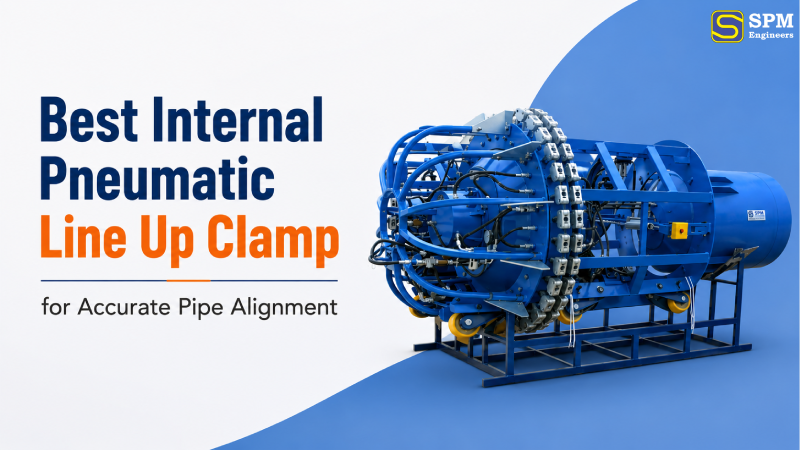
An INTERNAL PNEUMATIC LINE UP CLAMP is a precision tool designed to align two pipe joints from the inside during welding operations. Unlike external clamps that grip the pipe from the outside, this clamp is inserted into the pipe and positioned right at the weld joint. Once in place, it uses compressed air — typically at 100 to 145 psi — to expand its pneumatic jaws outward, gripping the inner wall of both pipe ends with firm, even pressure.
This internal grip holds the pipes in exact alignment, creating a stable, movement-free platform for welders to tack weld and complete the full weld pass. Once the weld is done, the clamp releases, travels on its own power to the next joint, and the cycle continues — fast, reliable, and consistent.
The result is cleaner welds, fewer defects, and a much stronger joint — which is critical when the pipeline will carry oil, gas, or water under high pressure over years of operation.
How the Clamp Works — Step by Step
The working process of our INTERNAL PNEUMATIC LINE UP CLAMP is straightforward once you understand the mechanics behind it.
First, the clamp is inserted into one of the pipe sections and pushed to the joint location. It sits right at the connection point between the two pipe ends. Once positioned correctly, compressed air is supplied to the clamp through an air hose connected to a compressor on the surface.
The air pressure activates the pneumatic jaws — which are roller-type actuating jaws — and they expand outward, gripping the inner wall of both pipes simultaneously with equal force. This is the key to perfect alignment. Because the force is applied evenly from the inside, both pipes are held in a perfectly centered position without any twisting, shifting, or offset.
Welders then perform tack welds around the joint to lock it in position. Once tacking is complete, the clamp is released and moves to the next joint under its own power using alloy steel wheels fitted to the body. A reserve air tank built into the system maintains adequate air pressure for lineup at the next joint even before the compressor catches up. This keeps production moving without unnecessary stops.
Key Features That Make It Stand Out
What separates a good internal clamp from a great one comes down to the features built into it. Here is what makes the clamps from SPM Engineers stand apart from the rest.
Independently Operated Pneumatic Jaws — The front and rear jaws of the clamp operate independently. This means the clamp can align pipes that have different wall thicknesses without any adjustment or compromise. In real pipeline work, this is more common than people think, and having this flexibility saves a lot of time on site.
Self-Propelled Travel — The clamp moves through the pipe to the next joint on its own power. This is a major productivity feature on large cross-country pipeline projects where manually pulling or pushing equipment between joints adds unnecessary time and labor.
Wide Diameter Range — Our clamps are available from 16 inches and above, with larger sizes available on request. Additionally, a conversion kit reduces the number of equipment a contractor must bring to the construction site by enabling a single clamp to cover two different pipe sizes.
No Pipe Damage — When used correctly, the clamp will not damage, deform, or bell-end the pipe. The roller-type jaws grip the inner wall firmly without leaving marks or causing structural weakening. This is important for maintaining the full integrity of every joint.
Reserve Air Tank — The built-in backup air tank maintains air pressure between joints, so the clamp is ready for lineup without waiting for the compressor to fill up again. The workflow on huge pipeline projects is reliably maintained by this modest element alone.
Robust Construction — The clamp is built to withstand pipeline spread operations — rough terrain, dust, extreme weather, and constant use. SPM Engineers builds these clamps with high-grade materials and alloy steel components that handle repeated expansion and contraction cycles reliably throughout the life of a project.
Where This Clamp Is Used
The INTERNAL PNEUMATIC LINE UP CLAMP is the preferred choice for a wide range of pipeline construction and maintenance applications. Here are some of the most common areas where our equipment is put to work.
Oil and Gas Pipelines — This is the primary application. Cross-country oil and gas pipelines require hundreds or even thousands of welded joints, and each one needs to be perfectly aligned. Our clamps are built exactly for this environment, where consistency across every joint directly affects the safety and performance of the entire pipeline.
Water Transmission Lines — Large-diameter water supply pipelines also benefit from internal alignment during welding. The same principles apply — a good weld starts with a perfectly held joint.
Industrial Plants and Refineries — Within plant environments, pipe sections often need to be welded in confined spaces. The internal clamp provides the alignment accuracy needed even when external access is limited.
Pipeline Repair and Maintenance — When a section of an existing pipeline needs to be replaced or repaired, the internal clamp makes it possible to align new pipe sections accurately without disrupting the surrounding infrastructure.
Why Proper Pipe Alignment Matters More Than You Think
Many people outside the pipeline industry underestimate how much impact alignment has on weld quality. When two pipes are even slightly off-center — whether by a few millimetres of lateral offset or a small angular deviation — the weld metal distribution changes. The result can be uneven penetration, stress concentration at the joint, or reduced fatigue life of the weld.
In an oil or gas pipeline operating at high pressures, these issues do not stay hidden for long. They show up as cracks, leaks, or catastrophic failures — all of which are far more expensive to fix after the fact than to prevent from the start.
Using an internal pneumatic clamp is not just about making the welder’s job easier. It is about building a pipeline that performs exactly as designed — safely, reliably, and for the long term.
Why Choose Us
At SPM Engineers, we do not just manufacture pipeline equipment — we build tools that field teams can count on when it matters most. Established in 2016 and based in Ahmedabad, India, we have grown into a trusted manufacturer and exporter of over 100 types of oil and gas pipeline equipment, shipped to customers across the USA, UAE, Russia, Australia, Malaysia, and many other countries.
Our INTERNAL PNEUMATIC LINE UP CLAMP is manufactured to the highest quality standards, using durable materials and precision engineering that holds up in even the most demanding field conditions. We back every product with deep technical knowledge, responsive customer support, and the flexibility to accommodate custom requirements — including conversion kits for different pipe sizes and larger diameter options on request. When you work with SPM Engineers, you get more than equipment — you get a partner who understands your project and is committed to your success.
Conclusion
Pipeline welding is one of the most demanding operations in the construction industry, and every weld joint carries significant responsibility. Using the right internal alignment tool is not optional — it is the foundation of a strong, safe, and long-lasting pipeline. The INTERNAL PNEUMATIC LINE UP CLAMP from SPM Engineers brings together precision engineering, field-proven durability, and practical design to give pipeline teams a tool they can rely on across every project, every joint, and every weld. When alignment is right, everything downstream falls into place — better welds, fewer defects, faster project completion, and a pipeline built to last for decades.
Planning a pipeline project and need the right alignment equipment? Get in touch with SPM Engineers today for expert guidance on selecting the best INTERNAL PNEUMATIC LINE UP CLAMP for your pipe size and project requirements.
Call us: +91 9974928709 Or Email us: info@spmengineer.com
FAQs
What is an Internal Pneumatic Line Up Clamp used for?
An INTERNAL PNEUMATIC LINE UP CLAMP is used to align two pipe joints from the inside before and during welding. It holds both pipe ends in a perfectly centered position using compressed air-powered jaws, giving welders a stable, movement-free surface to work on and producing cleaner, stronger weld joints.
What air pressure does the clamp require to operate?
The clamp operates on compressed air supplied at 100 to 145 psi (7 to 10 bars). The maximum safe working pressure for the clamp is 175 psi (12 bars). A reserve air tank built into the system maintains adequate pressure between joints, keeping the workflow consistent on the job site.
What pipe sizes does SPM Engineers’ clamp cover?
SPM Engineers manufactures internal pneumatic clamps starting from 16 inches in diameter and above. Larger sizes are available on request. A conversion kit also allows a single clamp to cover two pipe sizes, offering flexibility across different project specifications without needing separate equipment for each diameter.
Can the clamp handle pipes with different wall thicknesses?
Yes. The clamp features independently operated pneumatic jaws on the front and rear heads. This allows the clamp to align pipes that have varying wall thicknesses without any manual adjustment, making it highly practical for real-world pipeline projects where wall thickness variations are common.
Does using the clamp cause any damage to the pipe’s inner surface?
When used correctly, the clamp does not damage, deform, or bell-end the pipe. The roller-type actuating jaws grip the inner surface firmly and evenly, providing strong alignment without leaving marks or causing structural damage to the pipe — maintaining the full integrity of every weld joint.